

Non-PO invoices in Accounts Payable: choosing the right approval route
How to process a non-PO invoice by identifying the cost owner, evidence, accounting allocation and approval route without bypassing AP controls.
Read the article →
Purchase order, receipt and invoice: three-way matching in Accounts Payable
Compare purchase orders, receipts and invoices in Accounts Payable, resolve variances and prevent unsupported payments.
Read article →
Inventory transfers: shipped does not mean received
Reconcile warehouse transfer shipments and receipts, investigate quantities in transit and avoid unsupported Inventory data adjustments.
Read article →
Mixed PDF page sizes: how to agree correspondence print scaling
Agree paper size and PDF scaling, check the address window and prevent clipped content before correspondence printing and envelope inserting.
Read article →
Invoice holds in Accounts Payable: resolve the cause, not just the status
Distinguish AP invoice holds, define release conditions and verify validation results without bypassing the client's controls or permissions.
Read article →
PDF comments: what will actually appear on printed correspondence?
Separate working PDF comments from the recipient's letter, agree how annotations will print and check a proof before correspondence production and inserting.
Read article →
Journal reversals in RTR: an ERP plan is not proof of posting
Control journal reversals in Record to Report: source entries, posting status, batch errors and a clear handover of unresolved exceptions.
Read article →
Duplex mail printing: keeping different recipients' documents separate
Prepare correspondence for duplex printing: recipient boundaries, intentional blank pages, sheet counts and a proof before envelope inserting.
Read article →
Duplicate invoices in Accounts Payable: a resubmitted document or a new liability?
Identify duplicate invoices in Accounts Payable using document data, intake-queue checks, reviewed alerts and tests that distinguish legitimate invoices.
Read article →
Fonts in PDFs for business mail: embedding, subsets and missing characters
Check fonts in the final PDF, distinguish a valid subset from a missing font and identify missing characters before outsourced business-mail printing.
Read article →
Supplier statement reconciliation in Accounts Payable: from totals to explained items
Compare supplier statements with AP records using the correct reporting date, credit notes and partial payments, and expose differences hidden behind matching totals.
Read article →
Excel and CSV for mail personalisation: preserving leading zeros and identifiers
Preserve leading zeros, identifiers and accented characters in mailing data. A practical guide to CSV import, column types and checking exported files.
Read article →
Why does a logo look different on a printed envelope? Agreeing a print reference
Avoid guesswork in business print colour: ICC profiles, paper, screen previews, physical samples and a clear approval scope before production.
Read article →
Service acceptance in Accounts Payable: what to check before approving an invoice
How to confirm completed services before invoice approval: evidence, partial acceptance, milestone reconciliation and responsibilities in outsourced AP.
Read article →
Customer-supplied print materials: reconciling envelopes and paper in outsourcing
Track envelopes and paper supplied for outsourced printing: receipt, production consumption, waste, reservations, physical counts and material returns.
Read article →
Returned business mail: from an undelivered letter to corrected records
A practical workflow for undelivered letters: postal annotations, case links, address verification and controlled resending.
Read article →
After outsourcing: how to measure recovered capacity and real benefits
How can you tell whether outsourcing reduced costs, freed up capacity, improved quality or merely moved work? Use a practical benefits register and measurement plan.
Read article →
Back-office outsourcing bottlenecks: WIP, work item age and flow time
A practical way to spot bottlenecks: shared case definitions, WIP, open-item age, throughput and clear escalation rules.
Read article →
Credit Control outsourcing: ageing, DSO and receivables escalation
A practical receivables model covering ageing, DSO, contact priorities, disputes, escalation and measurable KPIs.
Read article →
Month-end close in finance outsourcing: calendar and reconciliations
A practical calendar for cut-off, reconciliations, exceptions and approvals shared by a company and its provider.
Read article →
KSeF in outsourced invoice workflows: 10 controls that protect the process
KSeF does not replace Accounts Payable. Review 10 controls for permissions, approvals, duplicates, outages and provider accountability.
Read article →
AI Act and document outsourcing: what to check with an automation provider
Combine document automation with risk control, human oversight, GDPR and measurable provider quality.
Read article →
European Accessibility Act and outsourced correspondence: a practical checklist
Turn accessibility requirements into a practical brief for templates, PDFs, print, testing and supplier accountability.
Read article →
Incident management in outsourcing: priority, escalation and response plan
P1–P4 severity, clear escalation, scheduled updates and a post-incident review help contain an incident without chaos or lost evidence.
Read article →
How to name business mail print files to avoid mistakes
A consistent file name makes a print batch easier to hand over. See how to combine a date, job identifier, document type and version.
Read article →Bulk mailing checklist: 7 checks before dispatch
The final check should connect source data, documents and physical mail items. These seven checks help identify discrepancies before dispatch.
Read article →
Cross-border outsourcing under GDPR: data maps, SCCs and access from outside the EEA
An EU supplier address does not prove that data stays in the EEA. Check cloud regions, support access, backups, subprocessors and the transfer mechanism.
Read article →
Back-office automation without losing control: four-eyes review, exceptions and decision trails
Automation should remove manual work, not accountability. Learn where sampling is enough, where a second reviewer is essential and how to route exceptions.
Read article →
Data retention in outsourcing: when to archive, delete and require evidence
“We delete data when the contract ends” is not enough. Define the clock, owners, exceptions, deletion method and evidence for every data category.
Read article →
Our new website: design a business envelope online
Our services are easier to explore, and you can now create an initial business envelope design directly on the website.
Read article →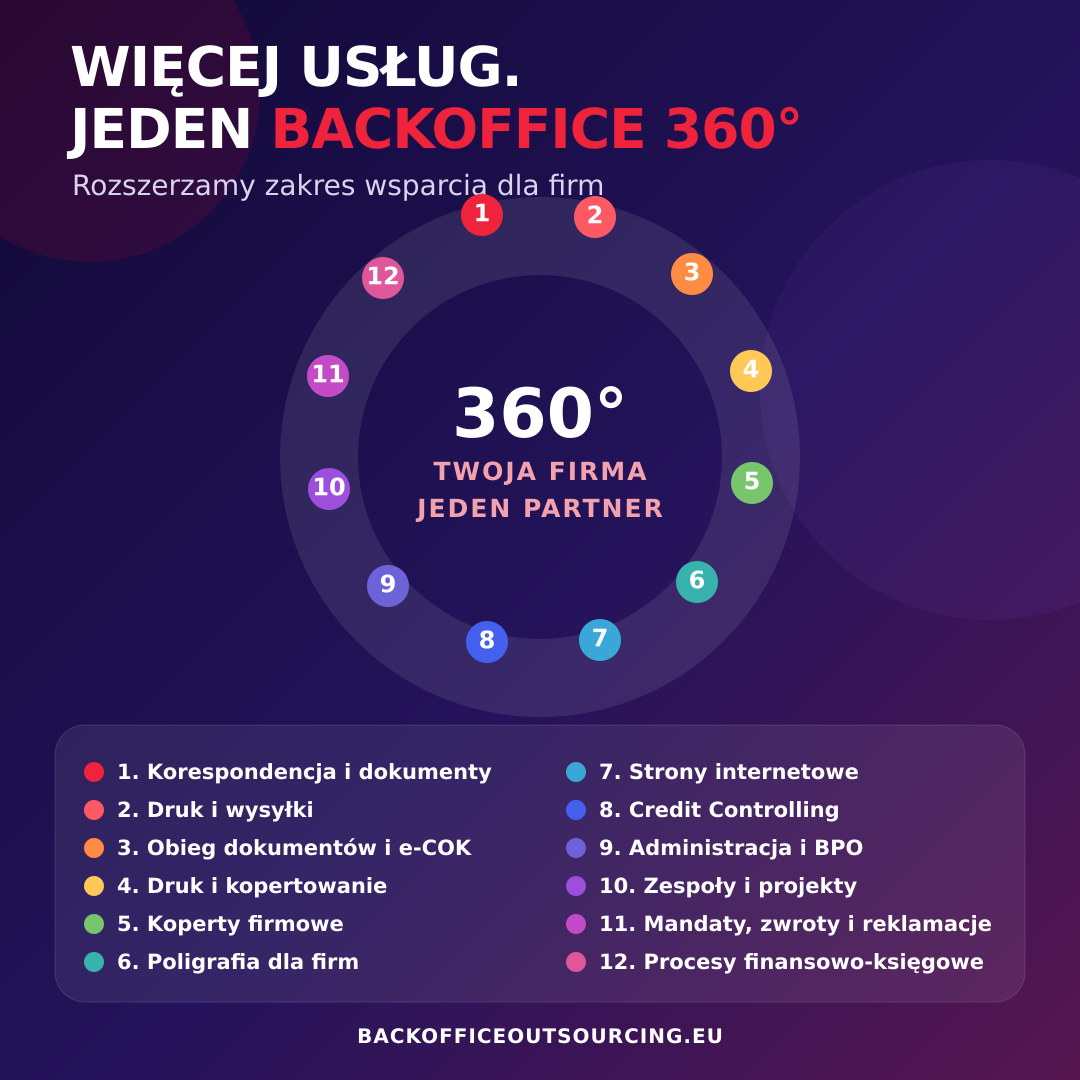
BackOffice 360°: expanding our service range for businesses
From correspondence and print to finance, administration, project teams and digital solutions - discover the expanded BackOffice 360° model.
Read article →
Subcontractors in outsourcing: how to control subprocessors and the full supply chain
A provider may deliver part of the service through partners. Keep responsibility, data and continuity visible across the entire chain.
Read article →
How to document outsourced business mail: audit trails and evidence of delivery
A completed status is not enough during a complaint or audit. Connect evidence from data receipt through production to dispatch.
Read article →
How to prepare outsourcing for seasonal volume peaks: forecasting, capacity and a surge plan
A volume peak does not have to cause delays. Combine rolling forecasts, capacity reserve, priorities and cost control.
Read article →
How to change outsourcing scope without chaos: change requests, version control and cost
A new template, report or volume can alter SLA and cost. Control every change from request and impact assessment to acceptance.
Read article →
Who is responsible for what in outsourcing? RACI, escalation and clear decision rights
An SLA does not allocate every decision. Assign client and supplier roles, build escalation paths and remove the operational grey zone.
Read article →
How to measure outsourcing quality: 12 KPIs that reveal more than SLA alone
Timeliness is only the beginning. Measure quality, security, cost and the supplier's ability to improve the process.
Read article →
Business continuity in outsourcing: how to keep mail operations running during disruption
An SLA does not help when systems fail, a site is inaccessible or a carrier stops collection. Build a continuity plan that can actually be used.
Read article →
How should outsourcing be priced? Fixed fee, unit price or hybrid model
The same service can look cheap or expensive depending on the pricing mechanism. Match the model to volume, capacity and risk.
Read article →
Full, partial or hybrid outsourcing? How to choose the right process model
The choice is not simply in-house or outsourced. Learn how to divide a process, control and accountability without creating costly handoffs.
Read article →
How to prepare a process for outsourcing: a 30-day transition plan without chaos
A good provider cannot repair an undocumented process overnight. Use this 30-day plan to prepare data, ownership, exceptions and a controlled pilot.
Read article →
How to choose an outsourcing provider: due diligence, SLA and exit plan in 10 steps
A unit price is not enough. Learn how to assess an outsourcing provider’s SLA, security, continuity and accountability before signing.
Read article →
Should you outsource correspondence handling? 12 questions that give a clear answer
A short test for owners, managers and administration teams. Check whether in-house mail still serves the business or has started slowing it down.
Read article →
What does correspondence outsourcing change? 8 benefits visible in everyday work
Less chaos, faster document flow and more time for the team. See the practical effects of a well-designed correspondence outsourcing process.
Read article →
Paper, email and e-Delivery in one workflow: how to keep important cases visible
Three channels, one register and clear ownership. A practical model for organising hybrid correspondence.
Read article →
What does in-house business mail really cost? 7 expenses hidden from the invoice
Salary is only part of the cost. See what else to include when comparing an internal process with outsourcing.
Read article →
Scanning business correspondence and the GDPR: 8 rules for a secure workflow
How to digitise business mail, restrict access to data and keep control of a document from receipt to archiving.
Read article →DL, C6/5, C5 and C4 branded envelopes: which format fits?
A practical comparison of envelope formats and how to combine efficient mailing with a professional brand image.
Read article →Bulk mailing without chaos: a 9-point checklist
A practical checklist before printing, inserting and dispatching a large batch of letters, invoices or notices.
Read article →Correspondence outsourcing: regain time and complete control
How outsourced business mail handling works, what can be delegated and how to recognise a well-designed process.
Read article →